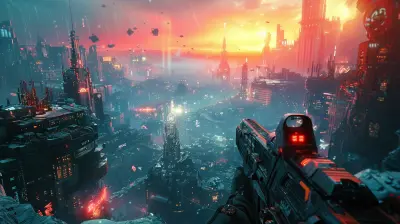
Finding Games That Promote Creativity and Problem Solving
29 January 2026
Let’s be real — not all games are just button-mashing madness and flashy visuals meant to kill time. Some are actually little treasure troves in disguise. Yep, I'm talking about those awesome games that get your creative juices flowing and make your brain do backflips. 🤯
In this article, we're diving deep into the world of games that are more than just entertaining distractions. These beauties promote creativity and sharpen your problem-solving skills, often without you even realizing it. Whether you’re a curious parent, a lifelong gamer, or someone just looking to level up their mental game — you're in the right place.
So, are you ready to find games that’ll make you think outside the box and maybe even build a few of your own virtual worlds? Let’s go!
Why Games Can Actually Be Brain Candy
First off, let’s clear something up. Playing games doesn’t mean you’re wasting time. Not all screen time is created equal. Some games challenge your brain in ways that are similar to solving puzzles, writing stories, or even mastering a new language.Think of games as modern-day playgrounds. They can teach strategy, boost imagination, and even improve decision-making. The trick is choosing the right ones. The ones that don’t just bombard you with explosions and eye candy, but ask you to think, create, and adapt.
What Makes a Game Good for Creativity and Problem Solving?
To put it plainly: these games make you work—but in a fun way.Here’s what to look for:
- Open-Ended Gameplay – No strict objectives. You get to create your path.
- Creative Tools – Whether it’s building, designing, or storytelling, you’re in charge.
- Challenging Puzzles – Ones that require logic, planning, and experimentation.
- Decision-Based Outcomes – Choices that truly impact the game’s direction.
- Resource Management – You learn to manage limited resources in smart ways.
Let’s check out the games that hit these marks.
Top Games That Promote Creativity and Problem Solving
1. Minecraft
Let’s be honest — you probably saw this one coming. But there’s a reason why Minecraft is still king of the creative mountain.In Minecraft, you’re dropped into a blocky open world and given one mission: survive and build. Whether you're constructing castles, designing redstone contraptions, or modding entire worlds, the possibilities are endless.
On top of that? There’s problem-solving galore. Need food? Gotta farm or hunt. Want to automate a machine? Time to tap into logic gates. It’s like LEGO with infinite bricks and monsters.
Why it works:
- Encourages spatial thinking and architecture.
- Teaches resource management and planning.
- You can play solo or collaborate with friends, which boosts social creativity.
2. Portal and Portal 2
These games are pure brain candy. In Portal, you're given a “portal gun” that lets you create entry and exit points on surfaces. Sounds simple? Wait till you’re suspended mid-air, trying to figure out how to fling yourself across a chasm.Every level is a puzzle that requires logic, timing, and creative thinking. Plus, the game throws in a sarcastic AI named GLaDOS that keeps you on your toes.
Why it works:
- Promotes abstract thinking and spatial awareness.
- Teaches cause and effect through physics-based puzzles.
- Makes failing actually fun — trial and error is encouraged.
3. The Legend of Zelda: Breath of the Wild
This isn’t just a game. It’s a masterpiece. Breath of the Wild drops you into a wild, open world where experimentation is key. Want to solve a puzzle shrine? You can use magnets, bombs, fire — basically, whatever your brain can cook up.The game rewards curiosity and resourcefulness. There’s rarely just one right answer, so creativity is part of survival.
Why it works:
- Encourages exploration and lateral thinking.
- Multiple solutions to problems build confidence and adaptability.
- Complex yet accessible physics engine that reacts to player creativity.
4. Kerbal Space Program
Ever dreamed of building your own spaceship and flying it to distant planets? In Kerbal Space Program, you get to do exactly that — if you can get it off the ground without exploding.This game is deceptively deep. You hire astronauts, design spacecraft, manage physics, and even plan orbital trajectories. Don’t worry though — failure here is part of the fun. Explosions are learning moments, not game overs.
Why it works:
- Teaches real-world physics and engineering concepts.
- Encourages planning, trial, and iteration.
- Develops systems thinking and analytical skills.
5. LittleBigPlanet Series / Dreams
Both developed by Media Molecule, these games are a creative playground. In LittleBigPlanet, you play through whimsical levels, and then — if you want — create your own. Dreams takes it one step further, allowing players to make full-blown games, animations, music, and art.It's like giving you a blank canvas and an unlimited set of paints.
Why it works:
- Builds storytelling, design, and logic development.
- Players learn basic programming through game mechanics.
- Community sharing fosters collaborative creativity.
6. The Witness
This one’s for the puzzle junkies. The Witness is a beautiful yet brain-busting game that drops you on an island filled with line puzzles. Sounds easy, right? Wrong.Each set of puzzles requires you to learn a new set of rules — without being told what they are. You learn through observation, pattern recognition, and a lot of “aha!” moments.
Why it works:
- Strengthens abstract reasoning and logic.
- No handholding — you must figure things out via observation.
- Builds patience and perseverance.
7. TIS-100 / Human Resource Machine / SHENZHEN I/O
These may sound like software at first glance, but don’t be fooled. These are logic puzzle games disguised as job simulators.Each of these games throws you into a fictional programming environment where you solve increasingly complex challenges using real coding logic. You’ll feel like a computer whisperer in no time.
Why it works:
- Teaches core concepts of programming and logic gates.
- Encourages efficiency and optimization.
- Develops resilience in the face of failure.
Even Mobile Games Can Flex Your Brain
Not all brain-boosting games need a high-end PC or console. Mobile has gems too!- Monument Valley – Artistic puzzles that twist your perception.
- The Room Series – Beautiful escape-room style mysteries for your pocket.
- Baba Is You – A puzzle game where you change the rules of the game… literally.
Yup, your smartphone can be more than just for doom-scrolling.
Board Games Count Too!
Hold up—this list just wouldn’t be complete without giving a shout-out to some offline classics. Board games are legendary for boosting creativity and problem-solving.Try these:
- Codenames – Sharpens your word association powers.
- Catan – Teaches strategic planning, bartering, and resource management.
- Dixit – A dreamy card game that thrives on imagination and storytelling.
- Escape Rooms (in-a-box) – Collaborative puzzles with real pressure and fun.
Gather some friends, bring snacks, and let the brain games begin.
Games in Education: Learning Disguised as Fun
Did you know many schools and educators now use games to teach? It’s true — gamified learning is on the rise. When students build cities in SimCity, learn physics in Kerbal, or tell stories with Minecraft, they’re not just playing — they’re learning.And honestly? That’s the magic of it. Learning doesn’t have to be boring. When you gamify a concept, engagement shoots through the roof. You make mistakes, try again, and eventually succeed — just like real life.
How to Choose the Right Game for You (or Your Kid)
Alright, so now you’re convinced. But where do you start? Here are some quick tips:- Know the interests – Love art? Try Dreams. Into science? Kerbal is gold.
- Set goals – Want better logic skills? Puzzle games are your go-to.
- Watch before you buy – YouTube and Twitch can show you how a game works.
- Don’t fear failure – The best games make learning from mistakes fun.
- Play together – Great for bonding and adds an extra layer of creative chaos!
Your Brain Will Thank You Later
So there you have it — games that aren’t just fun but secretly make you smarter. In a world filled with information overload, finding games that stimulate your creativity and stretch your problem-solving muscles is like finding a gem in the rough.Seriously, next time someone tells you “games are a waste of time,” hit them with your newfound knowledge. 🎮💡
Whether you’re building empires, solving ancient puzzles, or coding your own mini-games, remember — every session can be a step toward a sharper, more creative you.
Game on!
all images in this post were generated using AI tools
Category:
Parental Guide To GamesAuthor:

Tayla Warner
Discussion
rate this article
2 comments
James Hodge
Thank you for this insightful article! It’s refreshing to see a focus on games that foster creativity and problem-solving. I appreciate the recommendations and can’t wait to explore them further!
January 31, 2026 at 9:05 PM
Tayla Warner
Thank you for your kind words! I'm glad you found the article helpful and inspiring. Enjoy exploring the games!
Skyler Whitaker
Loved this article! It's refreshing to see games that not only entertain but also encourage creativity and critical thinking. Can't wait to try some of the recommendations—my brain could use the workout!
January 29, 2026 at 5:54 AM
Tayla Warner
Thank you so much! I'm glad you enjoyed the article and found the recommendations inspiring. Happy gaming!